

Military & Defense RF Materials for Radar, Electronic Warfare and ISR
Every domain. Every gram. Every dB.
Every soldier, vehicle, ship, and aircraft increasingly fight as nodes in one network. Drones, and distributed sensors feed command and control in near real time, radars build a shared air picture, and military networks lean on commercial SATCOM to stay connected. Each of those links runs through an antenna that must fit a platform, survive its environment, and keep working under jamming.
WavePro® ceramic-filled PTFE dielectrics give defense engineers more room to solve that problem: customer Dk from 2.0 and exceeding 20, low loss, and custom 3D shapes from flat laminates to lenses, domes and conformal parts. The result is smaller, lighter antennas and real reductions in size, weight, power and cost (SWaP-C) across radar; electronic warfare (EW); Intelligence, Surveillance, and Reconnaissance (ISR); and SATCOM programs.
Building for the space domain? Satellite, launch and ground-segment programs are covered on our Aerospace & Satellite page.
Land
Connected at the tactical edge.
Land forces carry the largest share of defense RF, and the battlefield keeps asking more of it. Soldiers and vehicles share data on the move, drones and unarmed ground vehicles report into command and control, and short-range air defense radars watch for incoming threats. Command posts must stay mobile and hard to find. Each new radio, datalink and radar must fit on a vehicle or a soldier that was already fully loaded.
With WavePro’s higher Dk, antenna elements and RF circuits get smaller, so designers hit aggressive SWaP-C targets without giving up gain, from handheld tactical radios and manpack SATCOM to vehicle-mounted radar. Custom copper cladding, thickness exceeding 10 mm and 3D geometries let designers adapt the RF component to the platform instead of the other way around. Smaller, lower-profile apertures also help keep vehicles and command posts discreet.
Naval
Built for decades at sea.
Navies protect the sea lanes that carry most of the world's trade, and modern warships pack their sensing into tight spaces. Integrated masts combine radar, ESM and communications apertures in one structure, submarine masts carry ESM and communications antennas, and uncrewed surface and underwater vehicles extend the fleet's reach. Topside hardware lives with salt, spray, vibration and thermal cycling for decades, and repairs often wait for port.
WavePro's PTFE base absorbs almost no water (0.02 to 0.10%) and resists chemical attack. It's far less brittle than pure ceramics, and all grades carry a UL-94 V-0 flammability rating. Panels up to 10 mm thick can replace bonded stacks of thinner sheets in radomes and large apertures: fewer bond lines, fewer failure points, more time on station.
Air
Phase-stable from runway to altitude.
In the air, what a platform can sense and share matters as much as how it flies. Fighters, ISR aircraft and UAVs carry radar, EW and datalink apertures behind radomes and conformal skins, and missile seekers pack an antenna array into a small space. Temperatures swing hard between the ground and altitude. A radome whose Dk shifts as it heats and cools bends the beam and costs pointing accuracy, and any added loss shortens range.
For radomes, WavePro's Dk 3.0 grade pairs a loss tangent of 0.0009 with Dk that holds within 0.3% of nominal from -50 to 150°C, so the beam stays where it's pointed. The same family extends to high-Dk grades, so radomes, lenses, seeker antennas and phased-array substrates can come from one supplier.
Electronic Warfare
Own the spectrum.
Electronic warfare is now the largest application for military antennas, spanning signals intelligence, anti-jam GPS, situational awareness and electronic attack. Forces depend on the spectrum and adversaries work to deny it, so the side that senses, protects and shapes it first holds the advantage.
EW apertures are rarely standard: wideband, conformal and often built for a single platform. WavePro's Dk is set to order in 0.1 steps, including layered or gradient Dk within one part, the basis of graded-index lenses. On the Dk 3.0 grade, measured Dk holds within 0.2% of nominal out to 2 THz, so wideband designs see the Dk they were modeled with. That makes it a fit for antennas, radomes, lenses and RF circuits, including the detection and direction-finding arrays behind counter-UAS.
Bring us the platform. We'll build the material around it.
Tell us the band, the size budget and the environment. Our RF team will recommend a WavePro grade or make one to your spec, then support you from prototype to fielded system.
Component Manufacturing
By leveraging milling, molding, sintering, and other manufacturing techniques, WavePro dielectrics and laminates can be formed into complex structures.
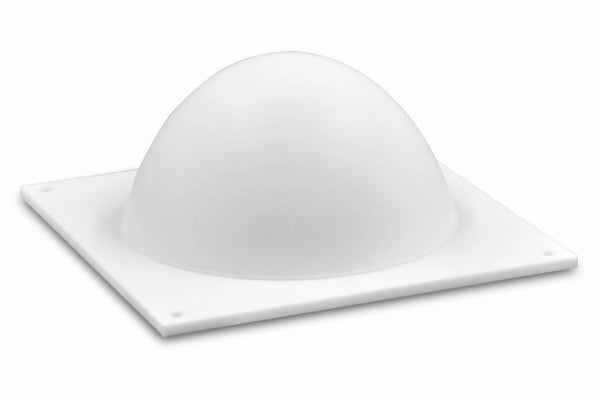
mmWave lensed radome
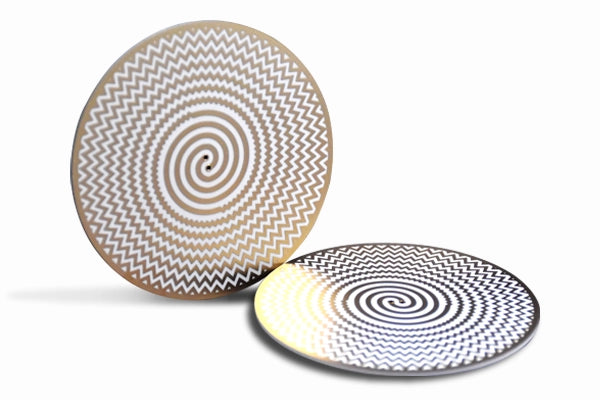
Spiral LPDA antenna
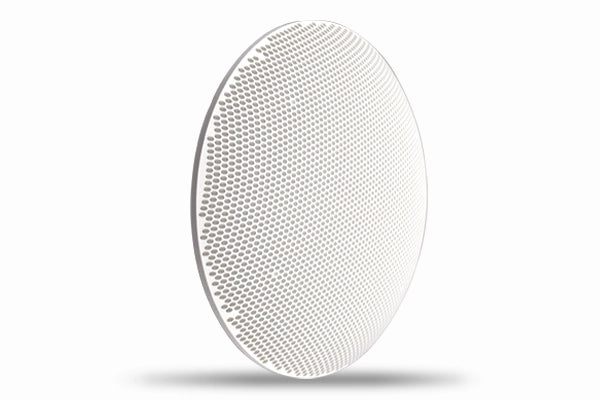
RF lens (Dk=9)
Available Product Formats

Dielectric Panels
WavePro® ceramic-filled PTFE dielectric panels are available in dielectric constants from Dk 2.0 to 20.4 and thicknesses from 0.25 - 10 mm. Ideal for RF lenses, radomes, and custom dielectric structures used in military and defense applications.
View ProductsLaminates
WavePro® RF laminates combine ultra-low loss dielectric performance with multiple copper cladding options for antenna, radar, and high-frequency PCB designs. Available in Dk values from 2.3 to 15.6 and thicknesses from 0.25 - 10 mm.
View Products

Build-to-Print Components
Transform your design into a finished RF component. WavePro® supports build-to-print manufacturing for custom antenna components, RF lenses, radomes, and other engineered dielectric solutions, including parts with thicknesses exceeding 10 mm. Submit your CAD or Gerber files for a quotation.
Request a Build-to-Print QuoteIndustry Certifications